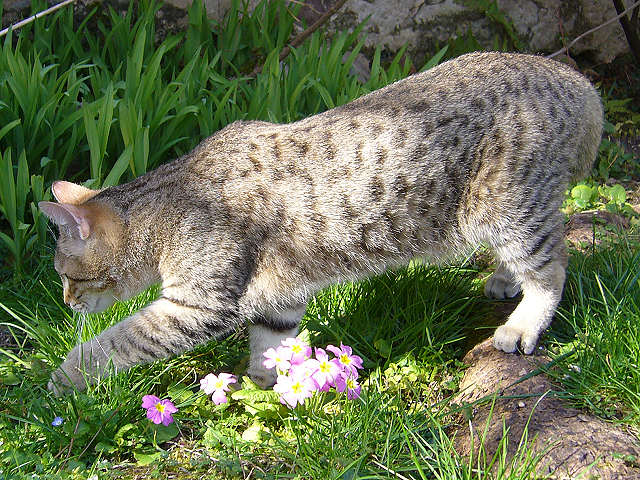
Bred to resemble the wild North American Bobcat, the Pixie-bob is a striking large breed with a short tail, tufted ears, and an unusually dog-like temperament. They are quiet, deeply loyal, and famously trainable — many learn to walk on a leash and play fetch.
- Origin
- Washington, USA
- Category
- shorthair
- Lifespan
- 13–16 yrs
- Size
- Medium-Large
- Weight
- 4–8 kg
- Coat
- Short or semi-long, double-coated, wild-looking spotted tabby
- Colours
- Brown spotted tabby only
😺 Temperament
🏡 Best suited to
📊 Personality ratings
📜 History & origin
The Pixie-bob breed traces to Washington State breeder Carol Ann Brewer, who in 1985 acquired a large polydactyl spotted male thought to be a barn cat × bobcat hybrid (later genetic testing showed no wild ancestry). The most influential founder kitten was named 'Pixie', and the breed took its name from her. TICA accepted the Pixie-bob for registration in 1994 and granted full Championship status in 1998. Polydactyl Pixie-bobs (with extra toes) are accepted in the breed standard — the only major breed where this is the case.
🧼 Care & grooming
Their double coat needs weekly brushing — twice weekly for the longhair variant. They are not climbers or jumpers in the way most cats are, but they need substantial daily play and are happy on a harness for walks. They form an unusually strong bond with one or two family members. Polydactyl individuals may need careful nail trimming on the extra toes, which sometimes lack a proper retractor mechanism.
🩺 Health notes
Generally a healthy breed with hybrid vigour. Hypertrophic Cardiomyopathy has occasionally been reported and reputable breeders screen with cardiac ultrasound. Their large size makes hip dysplasia a small risk. The polydactyly gene in the breed is a benign dominant mutation and not associated with health problems.


