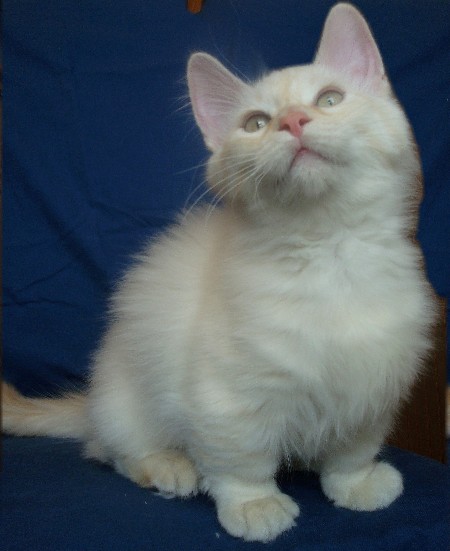
The plush-coated version of the short-legged Munchkin — a sociable, energetic little cat that scoots low to the ground yet keeps up with any playmate.
- Origin
- United States
- Category
- shorthair
- Lifespan
- 12–15 yrs
- Size
- Small
- Weight
- 2.5–4 kg
- Coat
- Semi-long, soft, silky
- Colours
- All colours and patterns
😺 Temperament
🏡 Best suited to
📊 Personality ratings
📜 History & origin
The Munchkin's very short legs are the result of a naturally occurring dominant genetic mutation, documented in cats since at least the 1940s and re-established from a Louisiana cat named Blackberry in the 1980s. The longhaired variety appears when the Munchkin's leg gene meets semi-long-hair lines. TICA accepted the Munchkin as a breed in 2003. It remains debated: some registries decline to recognise it over concerns about breeding for a skeletal trait.
🧼 Care & grooming
The silky semi-long coat needs brushing two or three times a week to stay tangle-free. Despite their short legs, Munchkins are fast, agile, and love to play — they simply take stairs and jumps a little differently. Keep them lean, as extra weight adds strain to their frame, and provide low, easy-access perches and litter trays.
🩺 Health notes
The dwarfing gene is tied to the breed rather than to a specific widespread disease, but lordosis (an exaggerated curve of the spine) and pectus excavatum can occur, and the gene is lethal when inherited from both parents, so breeders never pair two Munchkins. Choosing a breeder who screens carefully and keeps the cats fit is important.