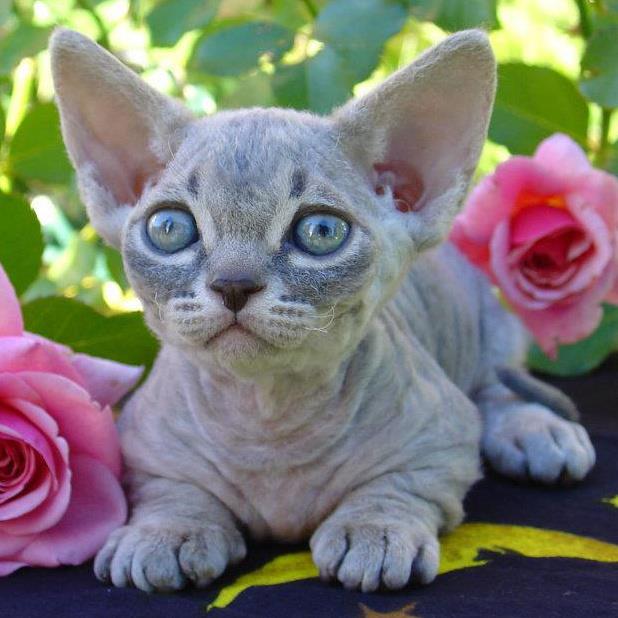
A tiny, short-legged cat with a near-hairless body and soft fur 'points' on its extremities — the feline answer to a Siamese pattern rendered in texture rather than colour. Warm, sociable and almost dog-like in its devotion, the Minskin is one of the newest and rarest of the dwarf breeds.
- Origin
- Boston, USA
- Category
- hairless
- Lifespan
- 12–15 yrs
- Size
- Small
- Weight
- 1.8–3 kg
- Coat
- Sparse, cashmere-like fur with denser 'points' on the face, ears, legs and tail
- Colours
- All colours and patterns
😺 Temperament
🏡 Best suited to
📊 Personality ratings
📜 History & origin
The Minskin was created in 2000 by Paul McSorley, a Boston breeder who set out to combine the short legs of the Munchkin with the sparse coat of the Sphynx, while adding the rounder features of breeds like the Burmese and Devon Rex. The name blends 'min' (for the miniature, Munchkin-derived legs) with 'skin' (for the exposed, Sphynx-like body). The first cat to show the desired look, a female named Tweedle, appeared in 2005, and by 2008 there were already around 50 Minskins. TICA accepted the breed into its Preliminary New Breed programme, and it remains a work in progress — carefully bred, closely monitored and still very uncommon worldwide.
🧼 Care & grooming
Despite looking hairless, the Minskin's exposed skin needs regular attention. The body produces normal skin oils that, without a full coat to absorb them, can leave the skin feeling greasy, so an occasional gentle bath and a weekly wipe-down keep it clean. The large ears collect wax and need routine cleaning, and the thin coat offers little protection from cold or sun — Minskins should live strictly indoors, be kept warm, and are happiest in heated homes or wearing a soft jumper in winter. They are robust eaters with brisk metabolisms to fuel their warmth, so feed a good-quality diet.
🩺 Health notes
As a young breed with a small gene pool, the Minskin is still being evaluated for inherited conditions, and responsible breeders screen for the issues associated with its founding breeds — including the skeletal concerns linked to the Munchkin's dwarfism gene and the heart condition (HCM) seen in several parent breeds. Reputable breeders avoid mating two short-legged cats together. Day to day, the priorities are skin care, ear hygiene, dental health and keeping the cat warm; a well-bred Minskin from a careful programme is generally an active, healthy little cat.